
Disclosure: This post is for informational and educational purposes only. FinanceCompassPro.com may earn compensation through display advertising. We may also reference third-party products, services, or platforms by name for educational purposes – these mentions are not paid endorsements unless explicitly stated. Nothing in this post constitutes personalized financial, legal, tax, or investment advice.
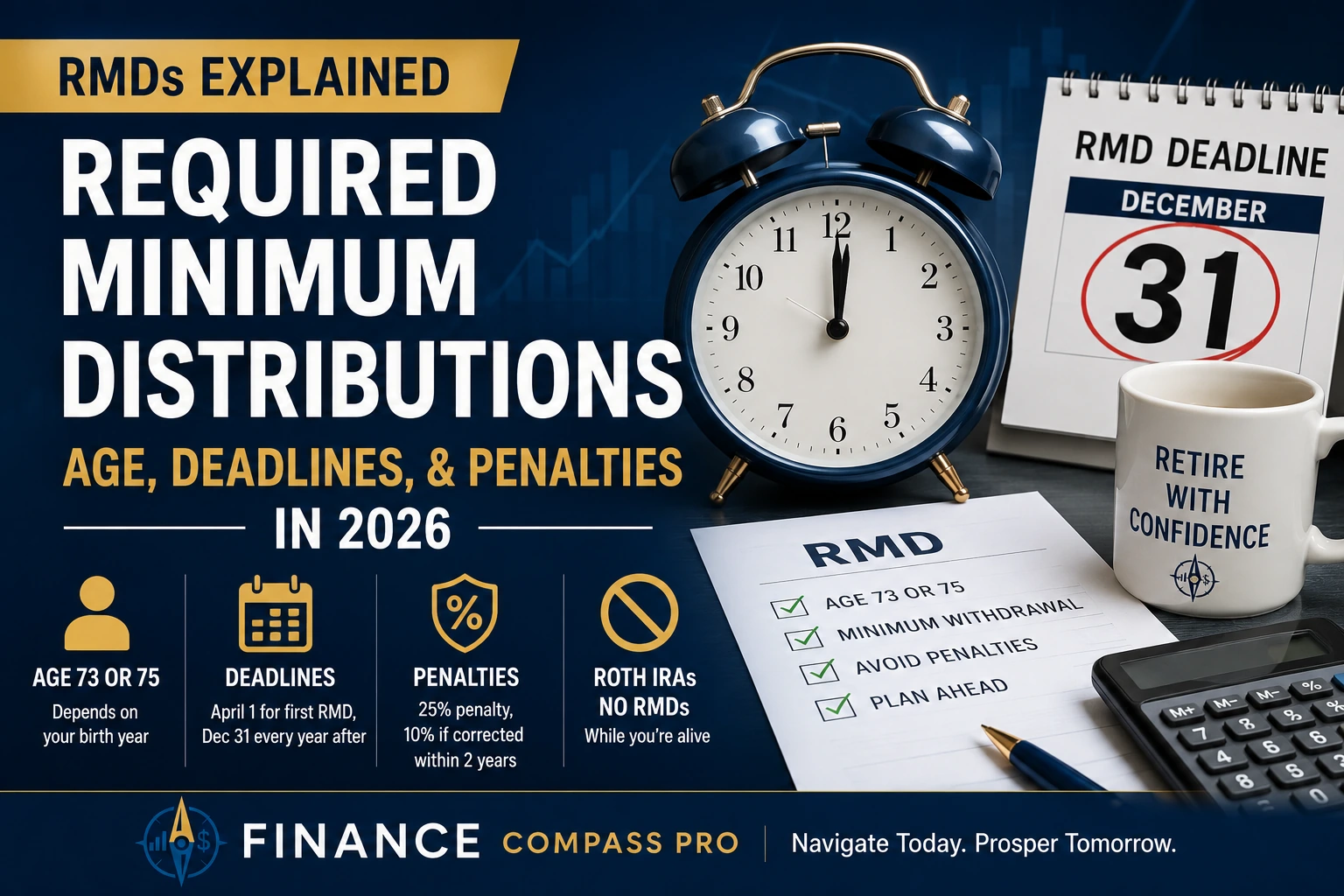
When do required minimum distributions (RMDs) start? The answer depends entirely on your birth year. If you were born from 1951 through 1959, your RMD age is 73. If you were born in 1960 or later, your RMD age is 75. Miss the deadline, and the IRS charges a 25% penalty on whatever you should have withdrawn.
RMD stands for required minimum distribution – the minimum amount you’re legally required to pull out of certain retirement accounts each year, starting at a specific age. You don’t get to leave the money growing tax-deferred forever. At some point, the IRS wants its share.
If you’re in your 20s or 30s, this probably feels decades away – because it is. I’ll explain later in this guide why it’s still worth understanding now. If you’re closer to your RMD age, or helping a parent think through theirs, this is the part that actually matters today.
Traditional IRA vs. Roth IRA explains why traditional IRA balances generally become subject to lifetime RMDs while Roth IRAs owned by the original account holder do not.
Quick Answer: Your RMD age is 73 if born 1951-1959, or 75 if born 1960 or later. Your first RMD is due by April 1 of the year after you reach that age; every year after, the deadline is December 31. Missing it triggers a 25% penalty (10% if corrected within two years). Roth IRAs owned by the original account holder have no lifetime RMDs at all.
- RMD age: 73 (born 1951-1959) or 75 (born 1960+)
- Miss a deadline: 25% penalty, reduced to 10% if fixed within 2 years
- Roth IRA (while you’re alive): no RMD required
Which Accounts Actually Require RMDs
RMDs apply to Traditional IRAs, SEP IRAs, SIMPLE IRAs, and most employer plans like 401(k)s, 403(b)s, and 457(b)s – basically any account where your contributions got a tax break going in.
| Account Type | RMD Required? |
|---|---|
| Traditional IRA, SEP IRA, SIMPLE IRA | Yes |
| 401(k), 403(b), 457(b) | Yes |
| Roth IRA (original owner, still living) | No |
| Roth 401(k) / Roth 403(b) | No (eliminated starting 2024) |
| Inherited IRA or inherited Roth IRA | Yes, different rules apply |
That last row is an important exception: even a Roth IRA, which has no RMDs for the original owner, does require them once it passes to a beneficiary. If you’ve inherited any retirement account, don’t assume the original owner’s rules still apply to you – the rules can be meaningfully different.

Why the Age Keeps Changing
The RMD age used to be a flat 72. The SECURE 2.0 Act moved it to 73 starting in 2023, and it’s scheduled to move again to 75 starting in 2033. It’s a phase-in, not a one-time jump, which is exactly why so many people get confused about which age applies to them.
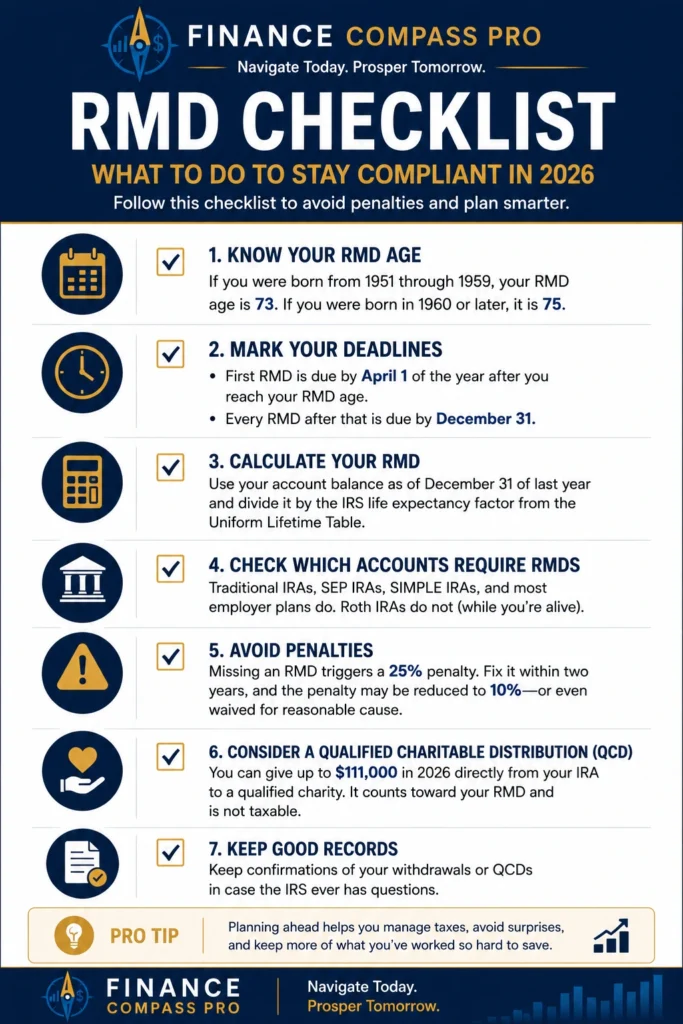
Here’s the simple version: if you were born from 1951 through 1959, your RMD age is 73. If you were born in 1960 or later, your RMD age is 75. There’s no in-between age – you fall into one bucket or the other based entirely on your birth year.
The First-Year Deadline Trap
This is the part that catches people off guard. For your very first RMD, you get extra time – you can wait until April 1 of the year after you reach your RMD age. Every RMD after that is due by December 31.
Here’s the trap: if you use that extra time and delay your first RMD into the following year, you still owe your second RMD by December 31 of that same year. That means two taxable withdrawals landing in one calendar year – which can push you into a higher tax bracket than if you’d just taken the first one on time.
Example: you turn 73 in 2026. You could wait until April 1, 2027 to take your first RMD. But you’d still need to take your 2027 RMD by December 31, 2027 – two withdrawals, one tax year, more taxable income than you might expect.
| Event | Deadline |
|---|---|
| First RMD | April 1 of the year after you reach your RMD age |
| Every RMD after that | December 31 each year |
| Missed RMD | 25% penalty on the amount not withdrawn |
| Corrected within 2 years | Penalty may drop to 10% |
How Much Do You Actually Have to Withdraw?
The formula is simple, even if it doesn’t feel that way at first: take your account balance as of December 31 of last year, and divide it by a life expectancy factor from an IRS table (most people use the Uniform Lifetime Table).
Example: you have $400,000 in a Traditional IRA and your life expectancy factor is 24.6. Your RMD would be $400,000 ÷ 24.6, or about $16,260 for the year. That life expectancy factor comes from an IRS table updated specifically for retirement distribution planning.
A few practical notes: you generally have to calculate the RMD for each account separately, though IRAs can often be aggregated and withdrawn from just one of them. Most brokerages will calculate this number for you automatically and can even set up automatic withdrawals, so you’re not doing the math by hand every year.
What Happens If You Miss the Deadline
The penalty used to be brutal: 50% of whatever you failed to withdraw. SECURE 2.0 cut that down to 25% – and if you catch the mistake and fix it within two years, it drops to just 10%.
To fix a missed RMD, withdraw the amount you should have taken, then file IRS Form 5329 with an explanation. If the mistake was a genuine error and you correct it promptly, the IRS will often waive the penalty entirely. For the official rules, see the IRS page on required minimum distributions.
One Strategy Worth Knowing: The Qualified Charitable Distribution
If you’re charitably inclined, this is worth understanding before your RMDs start. A Qualified Charitable Distribution (QCD) lets you send money directly from an IRA to a qualified charity – up to $111,000 in 2026 – and it counts toward your RMD without adding a dollar to your taxable income. You can make a QCD starting at age 70½, even though your actual RMD age may be later.
Compare that to a regular RMD withdrawal, which gets taxed as ordinary income whether you spend it or donate it afterward. A QCD skips that step entirely – the money never counts as your income in the first place.
Why This Isn’t Really About Beginners – But Still Matters
If you’re in your 20s or 30s building your first portfolio, RMDs are a decades-away problem, and there’s genuinely nothing to do about them today.
But here’s why it’s still worth knowing this exists: RMD rules are exactly the kind of thing that shapes decisions you’re making right now, decades before they apply. If you’re deciding between a Traditional and Roth IRA, knowing that Traditional accounts force withdrawals later while Roth accounts don’t is a real factor in that choice – not just a tax-bracket question.
And if you’re helping a parent or older relative navigate their own retirement accounts, this is one of the most common places people genuinely trip up. Missing an RMD has nothing to do with being a bad investor. It’s simply an administrative rule that’s easy to overlook – and an expensive one if you do.
If you’re still working out how your accounts fit together in the first place, our guide to retirement accounts for beginners walks through the 401(k), Roth IRA, and Traditional IRA side by side and which to prioritize first.
FAQ
A. No, not while the original owner is alive. This is one of the biggest structural advantages of a Roth IRA over a Traditional IRA. However, an inherited Roth IRA does have its own distribution requirements for the beneficiary.
A. In many cases, yes – if the RMD is from your current employer’s retirement plan and you’re not a 5% or greater owner of the business. This exception applies only to that employer’s plan, though. Traditional, SEP, and SIMPLE IRAs generally must start RMDs at your RMD age regardless of employment status.
A. You must calculate the RMD for each IRA separately, but you’re generally allowed to withdraw the total combined amount from just one of them. This is called aggregation. Workplace plans like 401(k)s typically don’t allow this – each one usually requires its own separate withdrawal.
A. Yes. The RMD is a minimum, not a maximum. You can withdraw more if you want or need to. However, extra withdrawals in one year don’t reduce or count toward the RMD you’ll owe in a future year – each year’s requirement stands on its own.
A. Take your retirement account balance as of December 31 of the previous year and divide it by your life expectancy factor from the IRS Uniform Lifetime Table. The result is the minimum amount you must withdraw for the year.
The Bottom Line
RMDs aren’t optional, and the penalty for missing one is steep enough to take seriously – 25% of the amount you should have withdrawn, even after SECURE 2.0 cut it down from 50%.
If you’re not close to your RMD age yet, the one thing worth remembering is simple: Traditional accounts eventually force withdrawals, Roth accounts don’t. If you are close, mark your calendar for April 1 of the year after you turn 73 (or 75), and know that delaying that first withdrawal means two RMDs hit the same tax year. Good retirement investing isn’t only about growing your money. It’s also about knowing when – and how – you eventually have to take it back out.
For the Roth-side contrast, Roth IRA Withdrawal Rules Explained covers contribution access, conversion clocks, and qualified distributions without lifetime RMDs for the original owner.
Disclaimer: This article is for educational purposes only and does not constitute personalized financial, legal, or tax advice. Retirement account rules, ages, and penalty amounts are subject to change. Verify current requirements with the IRS and a qualified tax professional before making withdrawal decisions.