Disclosure: This post is for informational and educational purposes only. FinanceCompassPro.com may earn compensation through display advertising. We may also reference third-party products, services, or platforms by name for educational purposes – these mentions are not paid endorsements unless explicitly stated. Nothing in this post constitutes personalized financial, legal, tax, or investment advice.
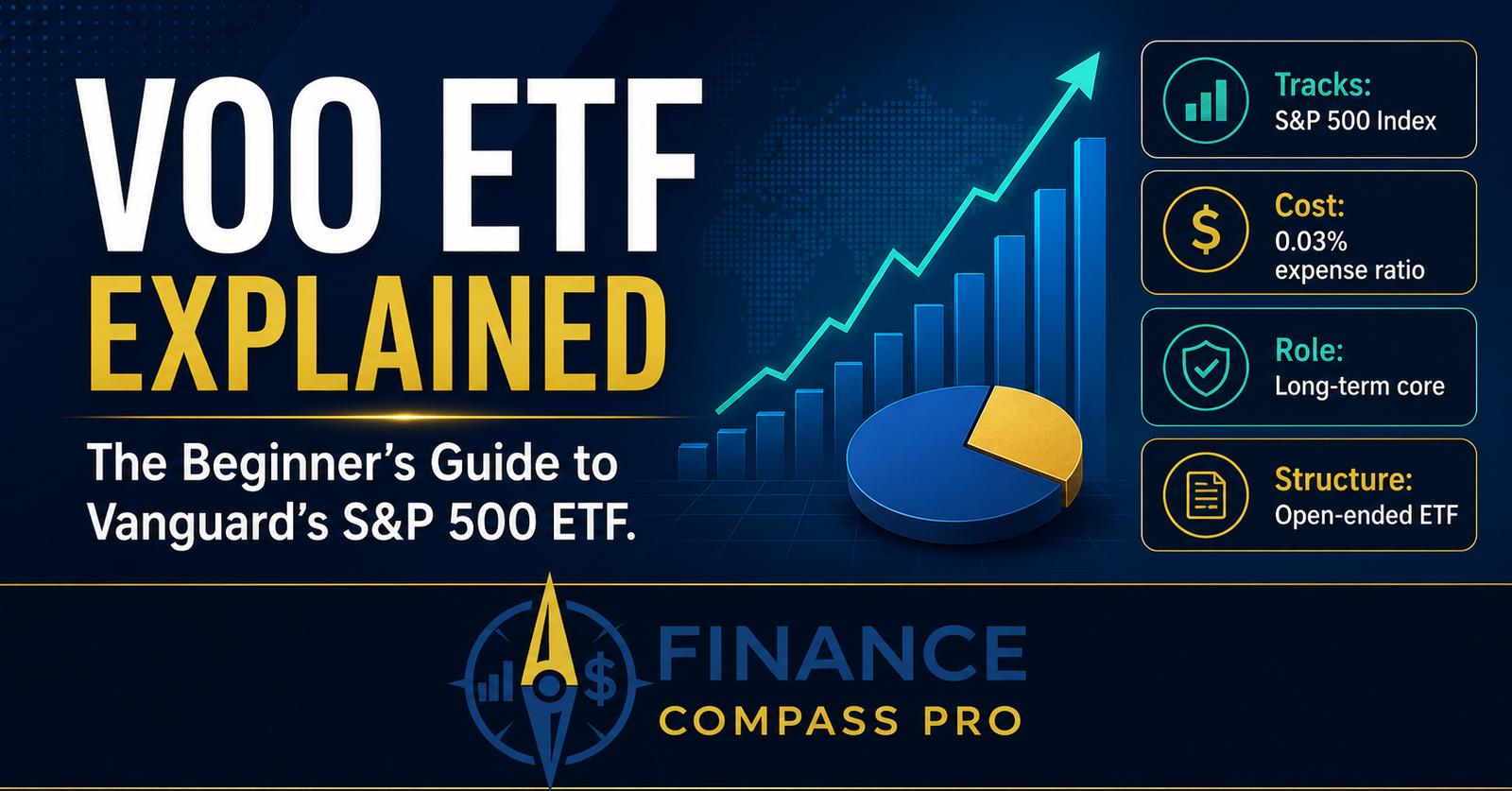
Many beginners assume all S&P 500 ETFs are identical – then pay roughly three times more for SPY without realizing it. On a $10,000 investment compounding at 7% annually over 30 years, that fee gap alone adds up to roughly $1,400 in lost returns. VOO is one of the largest and most widely held ETFs in the world. It charges 0.03% per year, tracks the S&P 500, and requires no active management on your part. For many beginners, it is the first ETF they ever buy – and for good reason.
But “low cost, tracks the S&P 500” only tells part of the story. Understanding what VOO actually holds, how it is structured, and where it fits relative to alternatives like VTI, SPY, and IVV helps you decide whether it belongs in your portfolio – and if so, how much of it.
This guide covers all of that in plain terms. If you are new to how ETFs work, see What Is an ETF? before reading on.
Quick Answer: VOO is the Vanguard S&P 500 ETF. It holds roughly 500 large U.S. companies for a 0.03% expense ratio – about one-third the cost of SPY. For most long-term buy-and-hold investors, VOO or the functionally equivalent IVV is the cost-efficient way to own the S&P 500.
What Is VOO?
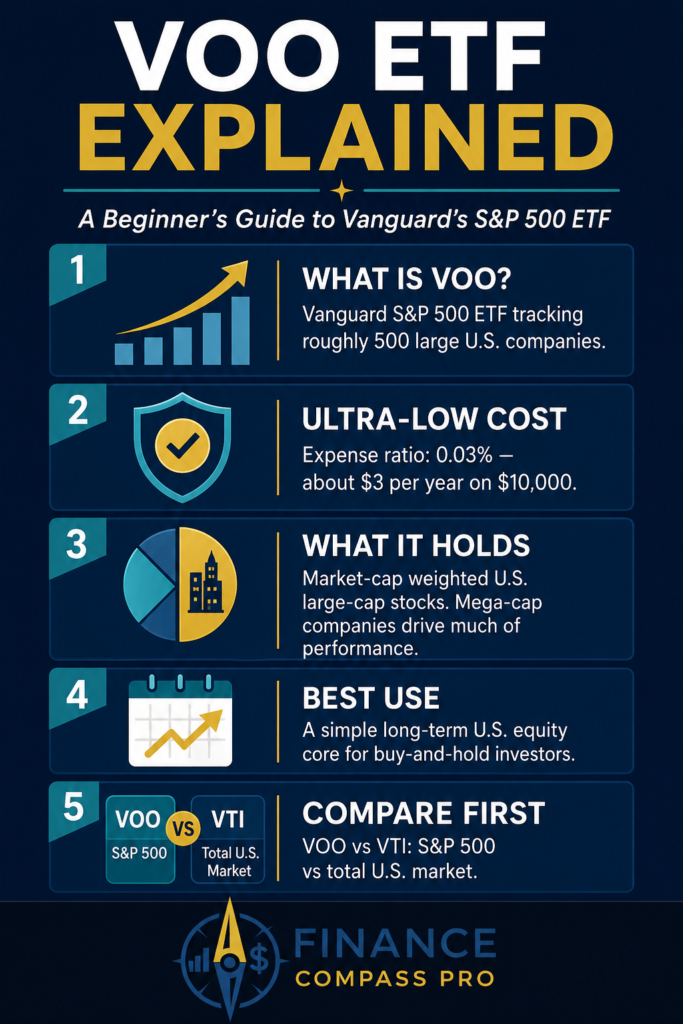
VOO is the Vanguard S&P 500 ETF. It tracks the S&P 500 Index – a market-cap-weighted index of roughly 500 large U.S. companies selected by a committee at S&P Dow Jones Indices. The fund uses full replication, meaning it holds all 500 stocks in the index in proportion to their weight.
Vanguard launched VOO in September 2010. It is structured as an open-ended ETF – a more flexible structure than the older Unit Investment Trust format used by SPY. That structure gives VOO more operational flexibility than SPY’s older UIT structure, including securities lending and more efficient handling of portfolio cash flows.
| Feature | VOO ETF |
|---|---|
| Full name | Vanguard S&P 500 ETF |
| Index tracked | S&P 500 Index |
| Replication method | Full replication |
| Expense ratio | 0.03% |
| Issuer | Vanguard |
| Number of holdings | ~500, varies over time |
| Legal structure | Open-ended ETF |
| Launched | September 2010 |
For official fund details, see the Vanguard VOO product page. Holdings, yields, and AUM fluctuate over time – verify current figures before investing.
What Does VOO Actually Hold?
VOO holds approximately 500 U.S. stocks, weighted by market capitalization. The largest companies by market value make up the biggest positions. Technology currently dominates the top of the list, with companies such as NVIDIA, Apple, Microsoft, Amazon, and Alphabet often among the largest holdings.
Because VOO is market-cap weighted, a relatively small number of large companies drive a significant share of its performance. The top 10 holdings can represent roughly one-third or more of the fund, depending on market conditions. This means VOO is more concentrated in mega-cap technology than its 500-stock count might suggest.
In terms of sector exposure, technology typically makes up the largest allocation, followed by financials, healthcare, and consumer discretionary. This mirrors the composition of the U.S. large-cap market at any given time – VOO is not making sector bets, it is simply holding the market as it is.
The Expense Ratio: Why 0.03% Matters
VOO charges 0.03% per year. On a $10,000 investment, that is $3 annually. On a $100,000 portfolio, it is $30 per year. By any measure, this is one of the lowest expense ratios available for any investment product.
Over decades, even a seemingly small fee gap can create a large difference in ending wealth because fees compound against you. For a full breakdown of how this math works, see ETF Expense Ratios Explained.
VOO vs. VTI: S&P 500 vs. Total Market
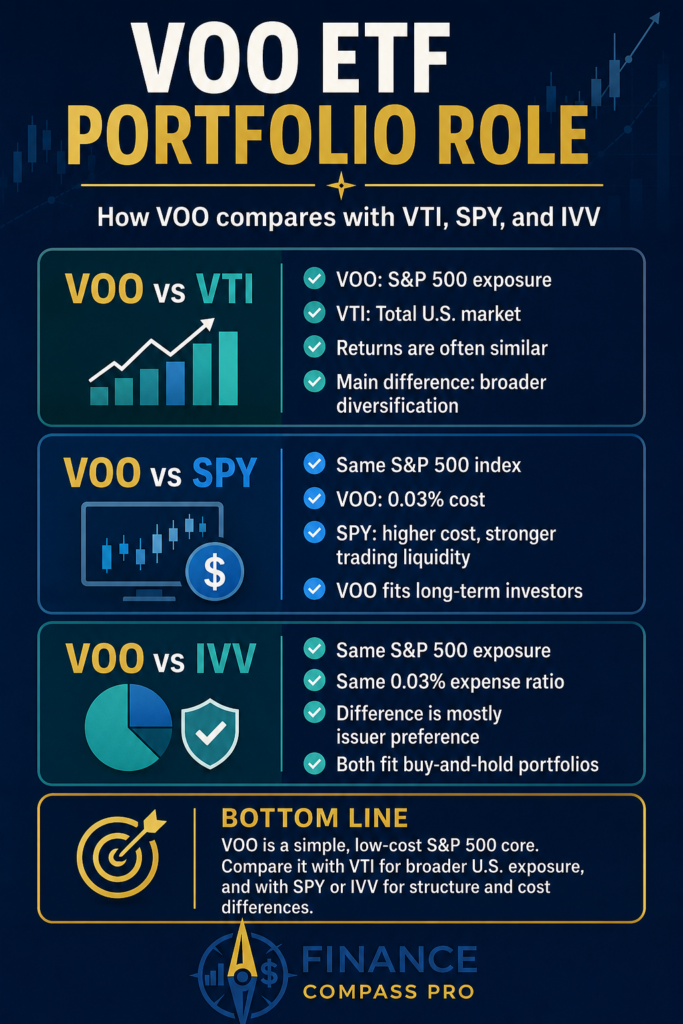
The most common alternative to VOO is VTI, the Vanguard Total Stock Market ETF. Both charge 0.03%. Both are from Vanguard. However, they track different indexes.
| VOO | VTI | |
|---|---|---|
| Index | S&P 500 (~500 large-cap stocks) | CRSP US Total Market (~3,600+ stocks) |
| Expense ratio | 0.03% | 0.03% |
| Coverage | ~80% of U.S. market by cap | ~100% of U.S. market by cap |
| Includes small/mid-cap | No | Yes |
| Historical return difference | Very similar to VTI over long periods | Very similar to VOO over long periods |
Because large-cap stocks dominate both indexes, VOO and VTI have historically produced very similar returns over long periods. The difference is diversification: VTI includes thousands of small- and mid-cap companies that VOO does not. Neither choice is inherently better – it depends on whether you prefer a pure large-cap portfolio or broader exposure to the U.S. stock market.
VTI ETF Explained takes a deeper look at how the total-market approach works on its own. Investors considering a growth tilt can also explore QQQ ETF Explained to see how a Nasdaq-100 allocation complements a core holding like VOO.
For a side-by-side comparison of the two Vanguard funds, see VOO vs. VTI.
VOO vs. SPY vs. IVV: Three S&P 500 ETFs
VOO, SPY, and IVV all track the S&P 500. Their day-to-day performance is nearly identical before fees. However, important structural and cost differences separate them.
| VOO | IVV | SPY | |
|---|---|---|---|
| Issuer | Vanguard | BlackRock (iShares) | State Street (SPDR) |
| Expense ratio | 0.03% | 0.03% | 0.0945% |
| Legal structure | Open-ended ETF | Open-ended ETF | Unit Investment Trust |
| Launched | 2010 | 2000 | 1993 |
| Best for | Long-term buy-and-hold | Long-term buy-and-hold | Active traders, options |
For most long-term investors, VOO and IVV are functionally equivalent. Both charge 0.03% and use an open-ended structure that allows dividend reinvestment and securities lending. The choice often comes down to platform preference, existing holdings, and personal simplicity rather than a meaningful performance difference. For a full breakdown of IVV, see IVV ETF Explained.
SPY charges roughly three times more than VOO and uses a legacy unit investment trust (UIT) structure.
For most long-term buy-and-hold investors who don’t rely on SPY’s trading and options features, VOO is usually the more cost-efficient choice.
Want to see the trade-offs in detail? VOO vs. SPY compares the two funds directly. SPY ETF Explained explores the ETF’s unique structure and why it remains the preferred choice for many active traders.
Tax Efficiency
VOO is highly tax-efficient. As an open-ended ETF, it uses in-kind redemptions to minimize capital gains distributions. VOO has historically been very tax-efficient, often distributing little or no capital gains to shareholders in taxable accounts.
Many dividends from broad U.S. equity ETFs like VOO may qualify for the lower qualified-dividend tax rate if holding-period requirements are met, but your Form 1099-DIV is the source of truth each year.
However, VOO still generates taxable dividend income each year in a taxable brokerage account. For investors who want to minimize current taxation, holding VOO in a Roth IRA or Traditional IRA shelters those distributions entirely. For a full breakdown of how ETF taxes work across account types, see ETF Taxes Explained.
Where VOO Fits in a Portfolio
VOO is a core holding, not a satellite position. It is designed to represent the entire U.S. large-cap equity market in a single fund – adding a second S&P 500 ETF alongside VOO does not improve diversification, it just duplicates it.
A straightforward portfolio might use VOO as the U.S. equity core, add an international fund like VXUS for global diversification, and a bond fund like BND for stability.
Together, these three holdings form the classic 3-fund portfolio. For that framework in detail, see The 3-ETF Portfolio Strategy.
Some investors add a dividend-focused satellite alongside VOO – for example, SCHD or VIG for an income or dividend-growth tilt. For a comparison of those options, see SCHD vs. VIG.
And if you are still deciding how much of your overall portfolio should go into U.S. equities, see our guide on asset allocation.
Who Should Consider VOO?
- Beginner investors who want simple, low-cost exposure to the U.S. large-cap market
- Long-term buy-and-hold investors building a retirement or brokerage portfolio
- Investors who prefer the Vanguard platform or already hold other Vanguard funds
- Anyone building a 3-fund or 2-fund portfolio who wants the U.S. equity component at the lowest possible cost
Investors who specifically want broader U.S. coverage including small and mid-cap stocks should consider VTI instead. Investors who need maximum liquidity or options market access may prefer SPY.
Both trade-offs are real, and both are covered in more detail in the comparison guides linked above.
FAQ About VOO
A. For many beginners, yes. VOO offers instant exposure to roughly 500 large U.S. companies at one of the lowest costs available. As a result, it removes stock-picking from the equation. However, it is 100% stocks, so it still carries full market volatility over short periods.
A. Both track the S&P 500, so their pre-fee performance is nearly identical. The differences are cost and structure. VOO charges 0.03% with a flexible open-ended structure. SPY charges 0.0945% and uses an older trust structure, but offers unmatched trading volume and options depth. Therefore, buy-and-hold investors usually lean VOO; active traders often prefer SPY.
A. Yes. VOO pays quarterly dividends from the S&P 500 companies it holds. Many of those dividends may qualify for the lower qualified-dividend tax rate if holding-period requirements are met. However, your Form 1099-DIV is the source of truth each year.
A. Neither is objectively better. VOO holds about 500 large-caps; VTI adds thousands of small and mid-cap stocks for the same 0.03% fee. Because large-caps dominate both indexes, long-term returns have been very similar. The choice comes down to whether you want pure large-cap or full-market coverage.
A. VOO holds roughly 500 large U.S. companies weighted by market cap. Historically, names like NVIDIA, Apple, Microsoft, Amazon, and Alphabet have been the largest positions. The top 10 holdings can represent one-third or more of the fund. Holdings change over time, so verify current data before investing.
A. VOO is a common core holding inside Roth IRAs. Its long-term growth compounds tax-free there, and qualified withdrawals avoid capital gains tax entirely. It also works well in taxable accounts due to its tax efficiency. Therefore, the decision depends on your overall account mix rather than the fund itself.
The Bottom Line
VOO is straightforward by design. It charges 0.03%, tracks the S&P 500, and holds roughly 500 large U.S. companies in proportion to their market size. For most long-term investors, that simplicity is a feature, not a limitation.
The biggest decision is not whether to use VOO or SPY – for many buy-and-hold investors starting fresh, VOO’s lower cost makes it more compelling than SPY.
The bigger question is whether you want pure S&P 500 exposure or broader total-market coverage via VTI. Both answers are defensible, and both funds are excellent tools for building long-term wealth at minimal cost.
For the broader picture of how core, dividend, international, bond, and growth ETFs fit together, see ETFs for Beginners: How to Choose, Compare, and Build a Simple Portfolio.