Disclosure: This post is for informational and educational purposes only. FinanceCompassPro.com may earn compensation through display advertising. We may also reference third-party products, services, or platforms by name for educational purposes – these mentions are not paid endorsements unless explicitly stated. Nothing in this post constitutes personalized financial, legal, tax, or investment advice.

Most beginner investors ask the same question when they start building a portfolio.
How many funds do I actually need?
The popular answer is three: a U.S. stock ETF, an international ETF, and a bond ETF. But there is another answer that often gets overlooked.
One fund. The entire world. Done.
That is the idea behind VT – the Vanguard Total World Stock ETF.
This guide explains what VT holds, how it compares to building your own multi-ETF portfolio, and whether it makes sense for beginners.
What Is VT?
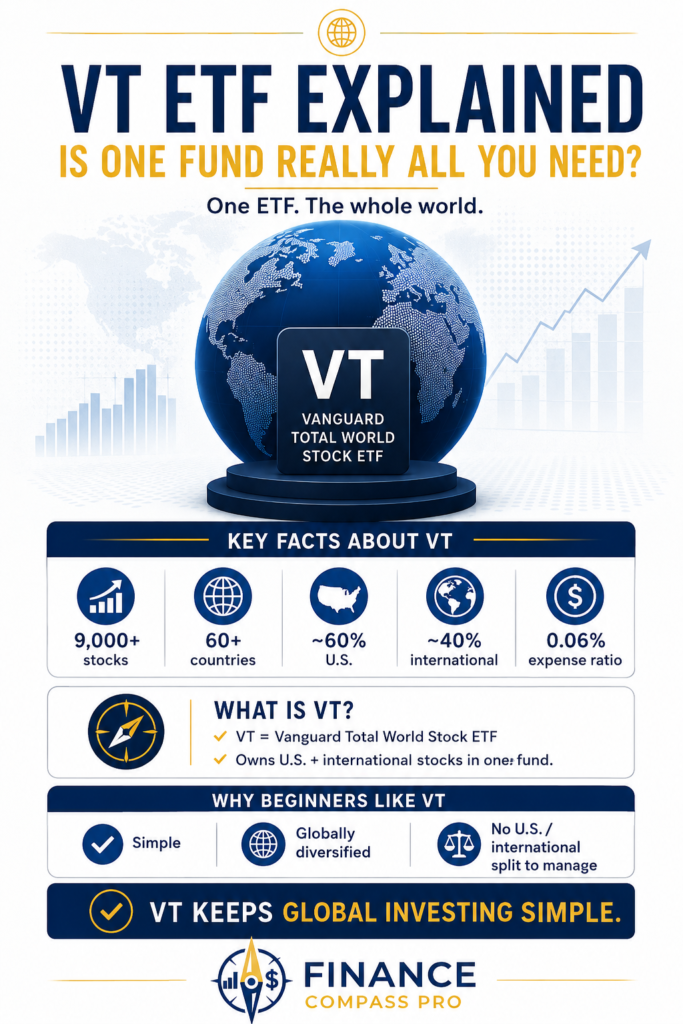
VT is the Vanguard Total World Stock ETF. It tracks the FTSE Global All Cap Index. That index covers publicly traded stocks from both developed and emerging markets around the world.
In short, VT gives you one fund that holds stocks from the United States, Europe, Japan, Canada, emerging markets, and everywhere else. You own a slice of the global economy in a single ticker.
| Feature | VT ETF |
|---|---|
| Full name | Vanguard Total World Stock ETF |
| Index tracked | FTSE Global All Cap Index |
| Holdings | 9,000+ stocks (varies over time) |
| Expense ratio | 0.06% |
| Issuer | Vanguard |
| U.S. allocation | ~60% |
| International allocation | ~40% |
| Typical portfolio role | All-in-one global equity core |
For official fund details, see the Vanguard VT product page.
What Does VT Actually Hold?
VT holds thousands of stocks from dozens of countries – usually more than 9,000 holdings depending on the reporting date. That makes it one of the most diversified single ETFs available to individual investors.
The fund is market-cap weighted. So larger companies make up a bigger share of the fund. Because U.S. companies dominate global market capitalization, the U.S. represents roughly 60% of VT.
The remaining 40% comes from international markets. That includes developed countries like Japan, the UK, Canada, and Germany. It also includes emerging markets like China, India, and Brazil.
In practice, VT is essentially VTI and VXUS combined into a single fund. If you already understand those two ETFs, VT is easy to grasp. If not, our guides on VOO vs VTI and VXUS ETF Explained explain both in detail.
VT vs. VTI + VXUS: What Is the Difference?
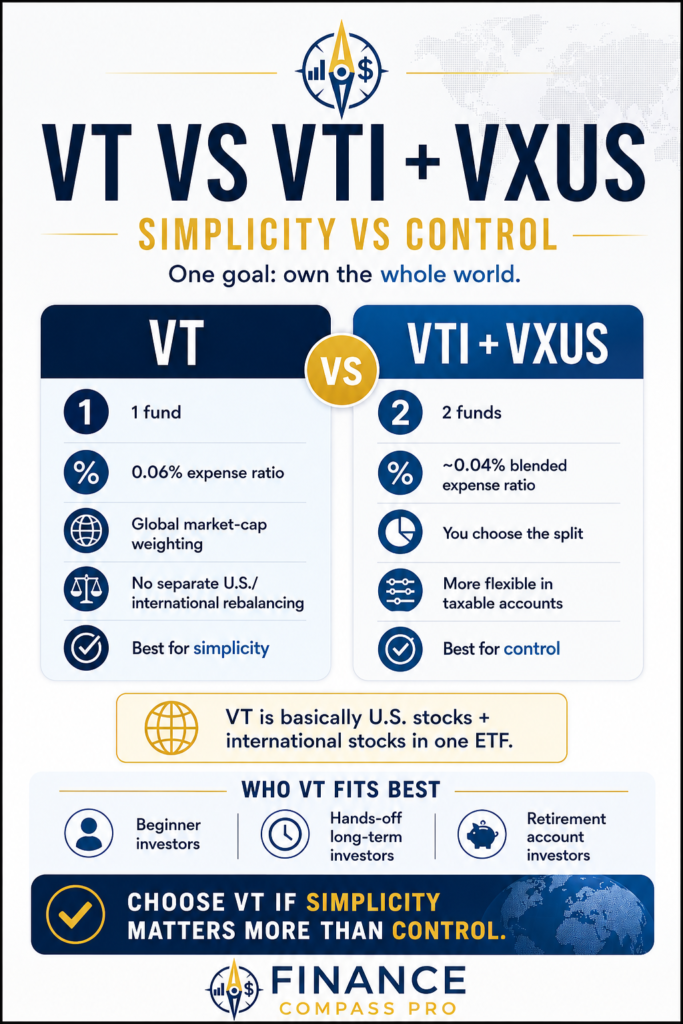
This is the most common question about VT. Many investors build a global equity portfolio by holding VTI and VXUS separately. VT does the same job in a single fund.
However, there are a few differences worth knowing about.
| VT | VTI + VXUS | |
|---|---|---|
| Number of funds | 1 | 2 |
| Expense ratio | 0.06% | ~0.04–0.05% blended |
| U.S. / International split | Set by market cap (~60/40) | You control the split |
| Rebalancing | No separate U.S./international rebalancing needed | Manual |
| Simplicity | Maximum | Slightly more complex |
| Tax-loss harvesting | Not possible | Possible between the two funds |
The biggest trade-off is control. With VTI and VXUS, you decide how much to allocate to the U.S. versus international markets. Before choosing a custom split, see Should Beginners Invest Internationally? How Much Global Exposure You May Need. VT removes that allocation decision by following global market weights.
For many beginners, that is actually a feature, not a limitation. It removes a decision point. You do not need to debate the right split. VT simply follows the market.
VT vs. VOO: Two Different Approaches
VOO tracks the S&P 500 – roughly 500 large U.S. companies. VT tracks the entire global stock market, including those same companies plus thousands more.
| VT | VOO | |
|---|---|---|
| Coverage | Global (60+ countries) | U.S. large-cap only |
| Holdings | 9,000+ | ~500 |
| Expense ratio | 0.06% | 0.03% |
| U.S. exposure | ~60% | 100% |
| International exposure | ~40% | None |
| Includes bonds | No | No |
VOO has outperformed VT in many recent years. That is because U.S. stocks – especially large-cap technology companies – have driven most of the global market’s gains. However, past performance does not predict future results.
Investors who choose VT are not betting that international stocks will outperform. They are simply choosing not to bet at all. Instead, they own the whole market and let market weights decide the outcome.
The Expense Ratio: Is 0.06% Worth It?
VT charges a 0.06% expense ratio. That is slightly higher than the cheapest broad-market ETFs like VOO or VTI, which charge 0.03%.
In dollar terms, on a $10,000 investment, VT costs $6 per year. VOO costs $3 per year. The difference is $3 annually – not a meaningful factor in long-term decision-making.
However, when you compare VT to holding VTI and VXUS separately, the blended expense ratio of a typical VTI + VXUS mix is closer to 0.04%, depending on the allocation. So you pay a small premium for the simplicity of a single fund – but the difference is only a few dollars per year on a $10,000 investment.
For more on how expense ratios affect long-term returns, see ETF Expense Ratios Explained.
The Case for VT
VT works particularly well in a few situations.
You want maximum simplicity. One fund covers global equities. There is nothing to rebalance between U.S. and international stocks. VT simply follows global market-cap weights inside one fund.
You want true global diversification. VT includes emerging markets and smaller developed economies that VOO misses entirely. That coverage may matter over very long time horizons.
You do not want to make a U.S. vs. international call. Many experienced investors argue that picking a U.S./international split is itself a form of market timing. VT removes that decision entirely.
You are investing in a retirement account. In a Roth IRA or 401(k), the simplicity of one fund makes it easy to set up automatic contributions and forget about it.
The Case Against VT
VT is not the right choice for everyone. There are real trade-offs.
You cannot customize the allocation. VT follows global market weights. If you want 80% U.S. and 20% international, VT does not give you that. You would need VTI and VXUS separately.
The expense ratio is slightly higher. At 0.06%, VT costs more than VOO (0.03%) or VTI (0.03%). Over 30 years, this difference is real – though small in absolute dollar terms.
No bond exposure. VT is 100% equities. It does not include bonds. So if you want a complete portfolio, you still need to add a bond component separately. For most beginners, BND is the natural pairing. For more on how bonds fit into a beginner portfolio, see BND Explained. If you are deciding between bond ETF options, AGG vs. BND compares the two most common choices.
Tax-loss harvesting is less flexible. With a single fund, you cannot harvest losses separately from the U.S. and international components. Investors using VTI + VXUS in a taxable account have more flexibility; ETF Tax-Loss Harvesting Explained covers that specific trade-off without expanding this product guide into a full tax section.
Where VT Fits in a Portfolio
VT works best as the equity core of a simple two-fund portfolio. You pair VT with a bond ETF and you are done.
| Investor Profile | Example Portfolio |
|---|---|
| Aggressive long-term investor | 90% VT + 10% BND |
| Moderate long-term investor | 70% VT + 30% BND |
| More conservative investor | 50% VT + 50% BND |
These are examples, not recommendations. Your actual allocation should depend on your risk tolerance, time horizon, income stability, and whether the money is in a taxable or retirement account.
This two-fund approach is one of the simplest complete portfolios available to individual investors. It covers global equities and bonds in two tickers.
Alternatively, VT works well inside a three-fund portfolio as a replacement for the VTI + VXUS combination. The result is the same global equity exposure, just packaged in one fund instead of two. For the full three-fund framework, see The 3-ETF Portfolio Strategy.
Is VT Right for Beginners?
Yes – with one condition. VT is an excellent choice if simplicity matters more than control.
For beginners who feel overwhelmed by portfolio decisions, VT removes a major source of confusion. No need to debate U.S. versus international allocations. No need to rebalance between two funds. Just buy VT, add BND based on your risk tolerance, and contribute consistently.
That simplicity has real behavioral value. Fewer decisions mean fewer chances to make emotional mistakes. And behavioral mistakes – panic selling, chasing performance, over-tinkering – often do more damage than any fund selection ever could.
However, if you want more control over your U.S. versus international split, or if you plan to tax-loss harvest in a taxable account, holding VTI and VXUS separately makes more sense. For a deeper look at VXUS itself, see VXUS ETF Explained.
The Bottom Line
VT is not a compromise. It is a deliberate choice to own the entire global stock market in one fund.
For investors who value simplicity, global coverage, and not having to manage a U.S./international split, VT delivers all three. The slightly higher expense ratio versus VOO or VTI is a small price for what you get in return.
The most important point is this: for many long-term investors, VT paired with a broad bond ETF can serve as a complete, globally diversified portfolio. Most investors never need anything more complex than that.
If you are still learning how much to put in stocks versus bonds, our guide on asset allocation explains how investors think about risk, time horizon, and portfolio balance.
If you are still deciding between building your own multi-fund portfolio or keeping it simple with VT, Best ETFs for Beginners covers all the core options side by side.