Disclosure: This post is for informational and educational purposes only. FinanceCompassPro.com may earn compensation through display advertising. We may also reference third-party products, services, or platforms by name for educational purposes – these mentions are not paid endorsements unless explicitly stated. Nothing in this post constitutes personalized financial, legal, tax, or investment advice.
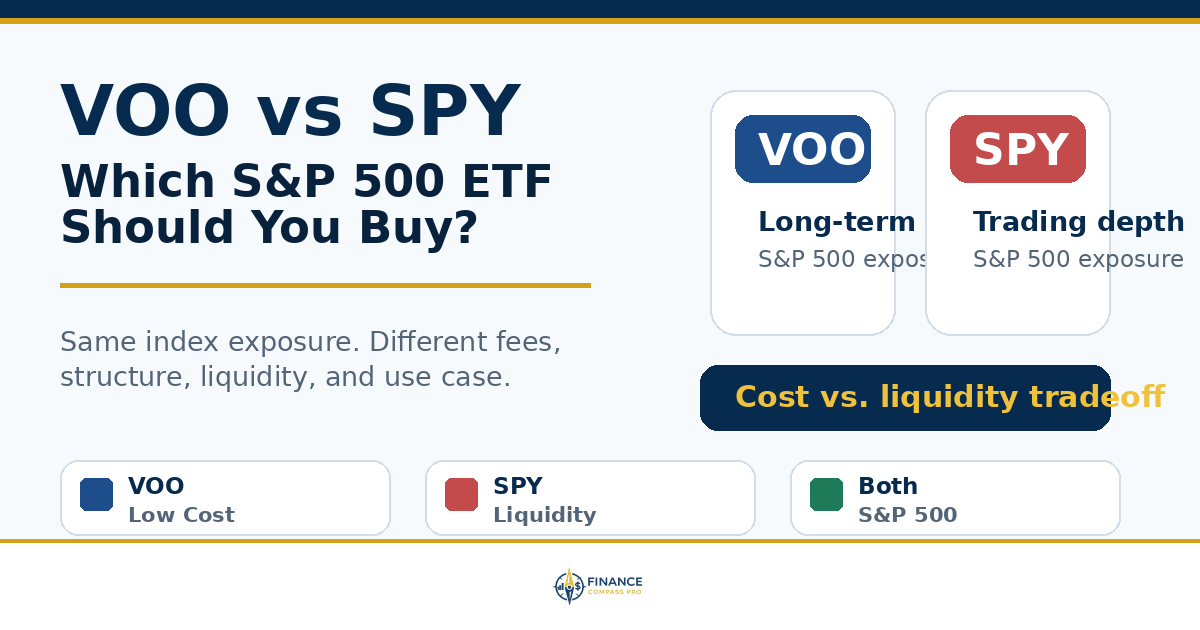
VOO charges 0.03% a year. SPY charges 0.0945% – roughly three times more – for tracking the exact same S&P 500 index. VOO and SPY both track the S&P 500, which means they give investors nearly identical exposure to large U.S. companies. Their holdings, sector weights, and long-term performance are usually extremely similar.
So why does the VOO vs. SPY comparison come up so often? Because the real differences aren’t about the index itself – they’re about cost, fund structure, liquidity, and how each ETF is typically used.
This guide explains the practical differences between VOO and SPY so you can decide which S&P 500 ETF fits your portfolio.
What Is VOO?
VOO is the Vanguard S&P 500 ETF. It tracks the S&P 500 index and is commonly used as a low-cost core holding by long-term investors. For a full individual breakdown of what VOO holds, its structure, and where it fits in a portfolio, see VOO ETF Explained.
The appeal is simple: VOO gives investors broad exposure to large U.S. companies at a very low expense ratio, which is one reason it has become so popular among long-term, buy-and-hold investors. For official fund details, see the Vanguard VOO product page.
For a deeper look at what the underlying index represents, see our guide on what the S&P 500 is.
What Is SPY?
SPY is the SPDR S&P 500 ETF Trust, issued by State Street. Launched in 1993, it was the first ETF ever listed in the United States. For official fund details, see the State Street SPY product page.
That trading depth is SPY’s defining feature. It’s widely used by traders, institutions, and options market participants because it typically offers extremely high liquidity, tight spreads, and one of the deepest options markets among ETFs. For a full individual breakdown of SPY’s structure, expense ratio, and who it’s designed for, see SPY ETF Explained.
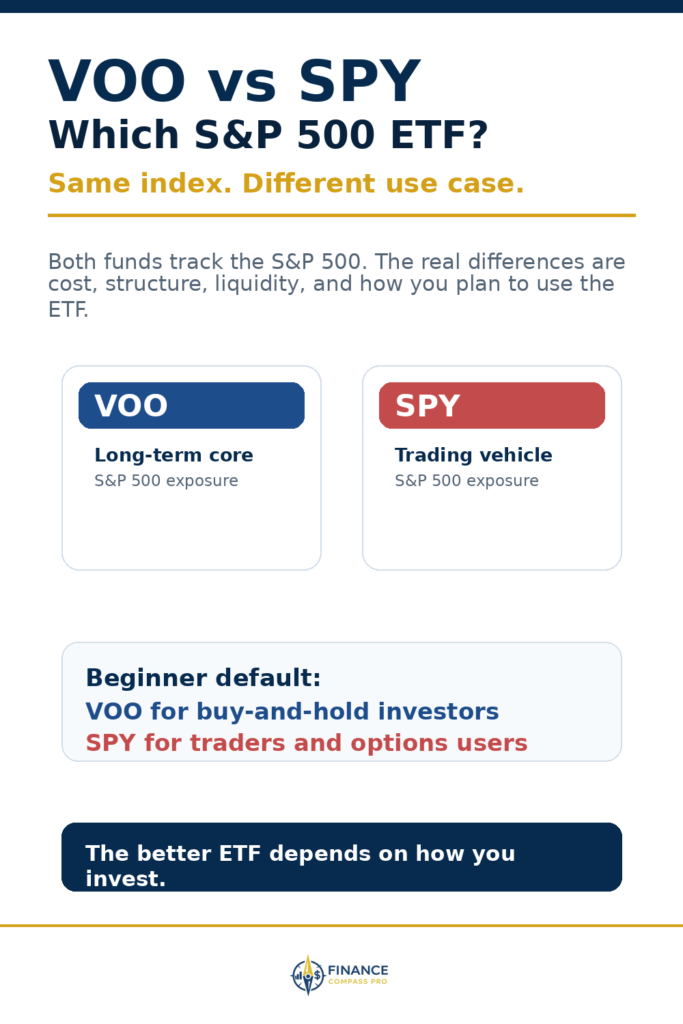
VOO vs. SPY: Key Differences
| VOO | SPY | |
|---|---|---|
| Issuer | Vanguard | State Street |
| Launched | 2010 | 1993 |
| Index Tracked | S&P 500 | S&P 500 |
| Expense Ratio | 0.03% | 0.0945% |
| Fund Structure | Open-end ETF | Unit Investment Trust (UIT) |
| Trading Liquidity | High | Highest of any ETF globally |
| Typical Portfolio Role | Long-term core holding | Trading and options vehicle |
| Options Market | Available | One of the deepest of any ETF |
Expense ratios and fund details can change over time. Verify current figures on each fund sponsor’s website before investing.
VOO and SPY are the two most commonly discussed S&P 500 ETFs, but they are not the only major options. IVV is another large, low-cost S&P 500 fund worth knowing about after you understand the VOO-versus-SPY trade-off.
The Fee Difference: Small Percentage, Real Dollars Over Time
VOO’s expense ratio of 0.03% versus SPY’s 0.0945% means SPY costs roughly three times more to hold, even though both funds deliver essentially the same underlying exposure to the same 500 companies. To understand how small fee differences compound into real dollars over decades, see ETF Expense Ratios Explained.
On a percentage basis, a roughly 0.06 percentage point gap sounds trivial. But for a long-term, buy-and-hold investor with no other reason to prefer SPY’s structure, that difference compounds over decades into a real – if modest – drag on returns. For an investor who simply wants S&P 500 exposure and plans to hold for years, there’s little reason to pay the higher fee.

The Structural Difference Most Comparisons Skip
The fee gap gets most of the attention, but VOO and SPY also use different fund structures.
SPY is structured as a Unit Investment Trust, an older ETF structure dating back to its 1993 launch. VOO uses a more standard open-end ETF structure. For most everyday investors, this difference isn’t something they need to manage directly, but it can help explain why two funds tracking the same index don’t always produce perfectly identical results after fees and fund mechanics.
One commonly cited limitation of SPY’s trust structure is that it doesn’t have the same operational flexibility as newer ETF structures – for example, dividend handling and securities-lending flexibility may differ from open-end ETFs such as VOO.
None of this makes SPY a bad ETF. It simply means that for a long-term investor who doesn’t need SPY’s trading and options advantages, VOO’s lower cost and simpler structure usually make more sense.
Why SPY Still Matters
SPY remains important because cost isn’t the only factor investors care about. For traders, institutions, and options users, liquidity can matter more than a small annual expense-ratio gap. SPY is consistently among the most-traded securities on earth, which matters enormously for a specific group of market participants:
- Options traders: SPY has by far the deepest and most active options market of any S&P 500 ETF, with tight bid-ask spreads across nearly every strike price and expiration.
- Institutional investors: Large funds moving significant capital in and out of positions benefit from SPY’s depth, which minimizes the price impact of large trades.
- Short-term traders: Tight spreads and high volume matter more to someone trading in and out frequently than a 0.06 percentage point annual fee.
For a long-term, buy-and-hold investor who isn’t trading options or moving institutional-sized positions, none of these advantages are particularly relevant – which is exactly why VOO tends to be the more common recommendation for beginners and retirement accounts.

Who Should Consider VOO?
- Long-term, buy-and-hold investors building a retirement or brokerage portfolio
- Investors who want the lowest possible cost for S&P 500 exposure
- Anyone who isn’t trading options or moving institutional-sized positions
Who Should Consider SPY?
- Active traders who value SPY’s exceptional liquidity and tight spreads
- Options traders who need SPY’s uniquely deep options market
- Institutional investors moving large positions frequently
- Investors who already hold SPY in a retirement account where it’s the only S&P 500 option available
Does It Actually Matter Which One You Pick?
For a new long-term investor choosing between the two today, the answer is yes, but the difference is usually modest. VOO and SPY provide nearly identical S&P 500 exposure, so the long-term gap mostly comes from fees, structure, and small tracking differences.
Investors starting from scratch with no existing position in either fund will usually find VOO the more sensible default for a long-term, buy-and-hold strategy. For someone who is not trading actively, there is little reason to pay a higher expense ratio for features they may never use.
Existing SPY holders are in a different position. Selling SPY just to buy VOO can trigger capital gains taxes in a taxable account, and the fee difference alone usually is not large enough to justify that cost for an existing position.
IVV is the other major S&P 500 ETF worth knowing about. If you want to expand this exact same-index comparison, see IVV ETF Explained. Broader U.S.-market and growth-tilt decisions belong to separate comparisons after the S&P 500 fund choice is settled.

The Bottom Line
VOO and SPY both track the S&P 500, so they give investors very similar exposure to large U.S. companies. The real differences are cost, structure, liquidity, and use case.
For most beginners and long-term buy-and-hold investors, VOO is usually the simpler default because it has a lower expense ratio and is built for long-term core exposure.
SPY still has a clear role. Its exceptional liquidity and deep options market make it valuable for active traders, institutional investors, and options users. But if you’re simply building a long-term portfolio around the S&P 500, you probably don’t need to pay extra for those trading advantages.
READY TO KEEP BUILDING?
For the broader ETF framework beyond this same-index comparison, see ETFs for Beginners: How to Choose, Compare, and Build a Simple Portfolio.
Once you’ve settled on a core holding, see our guide to the 3 ETF portfolio strategy for a simple way to build out a complete, diversified portfolio around it.