Disclosure: This article is for educational purposes only and does not constitute financial or tax advice. James Morgan is a personal finance writer, not a licensed financial advisor or tax professional. Always consult a qualified tax professional before making decisions based on your tax situation.
Many beginner investors assume ETF taxes only matter when they sell. That is only partly true.
In a taxable brokerage account, an ETF can create a tax bill in two main ways: when it pays a taxable distribution and when you sell shares for a profit. Reinvesting a dividend does not make it tax-free, but an increase in the ETF’s market price is generally not taxed until you sell.
The account holding the ETF matters just as much as the fund itself. A taxable brokerage account may generate annual taxes, while a Traditional IRA or 401(k) generally defers taxes until withdrawal. A Roth IRA does not create an annual tax bill, and qualified withdrawals are tax-free.
This guide explains when ETF taxes arise, how dividends and capital gains are treated, why ETFs are often more tax-efficient than mutual funds, and how beginners can reduce unnecessary tax drag without building an overly complicated portfolio.
Quick Answer
ETFs are generally taxed when they distribute taxable income or when you sell shares for a gain. In a taxable brokerage account, dividends may be taxable even when automatically reinvested, while unrealized price gains are not taxed until the shares are sold. Traditional retirement accounts generally defer taxation until withdrawal, and qualified Roth IRA withdrawals are tax-free.
Two Ways ETFs Generate Taxable Events
When you invest in an ETF, taxes can arise in two ways.
First, when the ETF distributes dividends. Most broad-market and dividend ETFs pay dividends quarterly. Those distributions are taxable in the year you receive them – even if you reinvest them automatically.
Second, when you sell your shares. If you sell an ETF for more than you paid, you owe capital gains tax on the profit. Specifically, the rate depends on how long you held the shares.
Both of these only apply in taxable brokerage accounts. However, in tax-advantaged accounts like a Roth IRA or Traditional IRA, neither event triggers a tax bill while the money stays in the account.
Capital Gains Tax: Short-Term vs. Long-Term
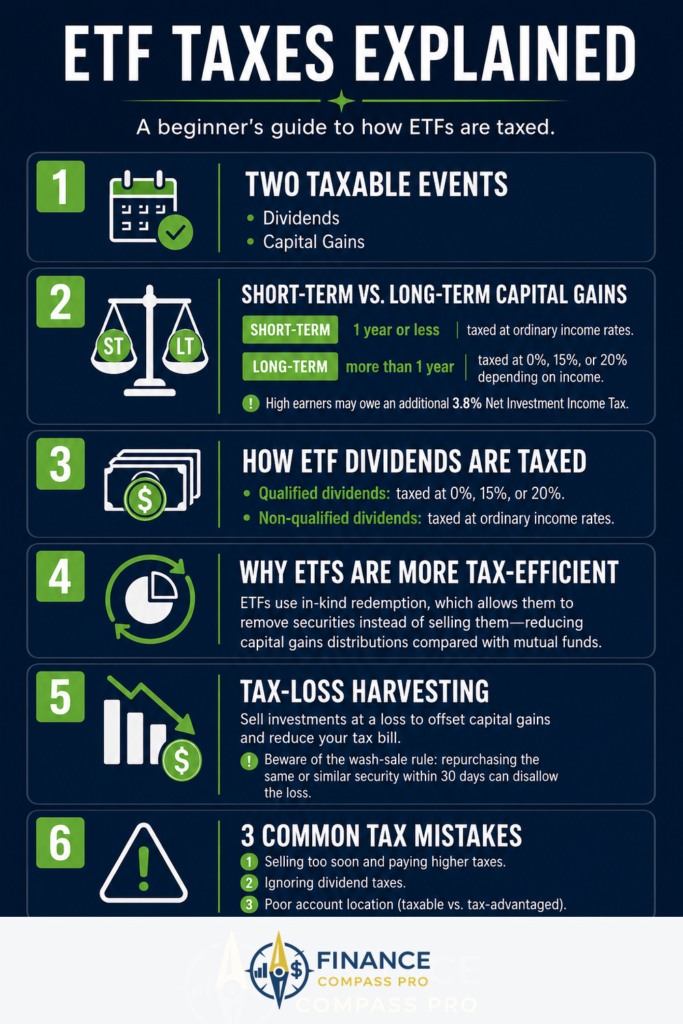
Many beginners assume unrealized gains are taxed every year. They are not. Until you actually sell, paper gains create no tax bill. When you do sell at a profit, the gain equals your sale price minus your cost basis. That gain is then classified as either short-term or long-term. In short, your holding period determines which tax rate applies. For the full mechanics of this rule beyond ETFs specifically, see Capital Gains Tax for Beginners.
| Holding Period | Tax Rate | Example |
|---|---|---|
| Less than 1 year (short-term) | Ordinary income rate (up to 37%) | Bought in January, sold in October |
| More than 1 year (long-term) | 0%, 15%, or 20% depending on income | Bought in 2023, sold in 2025 |
The difference is significant. Short-term gains are taxed like ordinary income – at whatever rate applies to your tax bracket. Long-term gains are taxed at preferential rates, which for most individual investors fall at 0% or 15%.
This is one of the strongest arguments for a buy-and-hold approach. Simply holding an ETF for more than one year before selling can cut your tax rate dramatically.
Two additional notes on accuracy: these brackets are federal rates only – many states also tax capital gains, often as ordinary income, so your total bill depends on where you live. Separately, higher earners may owe an additional 3.8% Net Investment Income Tax (NIIT) on top of the federal capital gains rate once income passes certain thresholds. Consult a tax professional for how these apply to your specific situation.
How ETF Dividends Are Taxed
Dividends from ETFs fall into two categories: qualified and non-qualified. The distinction matters because they are taxed at different rates. In short, qualified dividends get the lower long-term capital gains rates. Non-qualified dividends, however, are taxed like ordinary income. For the full rules on what makes a dividend qualify, including the holding-period test, see Qualified vs. Ordinary Dividends.
| Dividend Type | Tax Rate | Typical Source |
|---|---|---|
| Qualified dividends | 0%, 15%, or 20% (same as long-term capital gains) | Most U.S. stock ETFs held for required period |
| Non-qualified dividends | Ordinary income rate (up to 37%) | REITs, short-term holdings, some international ETFs |
Most dividends from broad-market U.S. ETFs like VOO, VTI, or SCHD are qualified. However, dividends from REIT ETFs are generally non-qualified and taxed as ordinary income.
That is one reason many investors prefer to hold REIT ETFs inside tax-advantaged accounts. Among dividend ETFs specifically, higher-yielding funds like SCHD generate more annual taxable income than lower-yielding, growth-oriented funds like VIG – see SCHD vs. VIG for how that tradeoff plays out.
Dividend-growth ETFs like DGRO tend to fall in between, with a moderate yield that produces moderate annual tax drag. For a direct look at how SCHD and DGRO compare on tax drag, see SCHD vs. DGRO.
Investors often weigh VIG vs. DGRO on exactly this point. Specifically, their different yields produce different levels of annual tax drag in a taxable account.
Growth-focused funds sit at the other end of the spectrum. Because QQQ pays such a small dividend, it creates minimal annual tax drag – QQQ ETF Explained covers how that plays out.
Losses can also work in your favor. In a taxable account, realized losses offset realized gains and can lower your bill – ETF Tax-Loss Harvesting Explained walks through how it works.
Account choice changes the math here. Income-heavy funds gain the most from tax-free growth, and Best ETFs for Roth IRA ranks which fund types benefit most.
If you also have access to a workplace 401(k), see Can You Have a Roth IRA and a 401(k) at the Same Time? for how the two accounts work together.
If your income is too high to contribute to a Roth IRA directly, see Backdoor Roth IRA Explained for the tax reporting involved in an alternative path.
High-dividend ETFs like VYM sit above DGRO in yield, generating more annual income – and more tax drag – in a taxable account.
Bond ETFs follow a different rule entirely – interest from funds like AGG and BND is taxed as ordinary income, not as a qualified dividend.
Your brokerage will send you a Form 1099-DIV each year showing the breakdown of qualified versus non-qualified dividends. You do not need to calculate this yourself.
Why ETFs Are More Tax-Efficient Than Mutual Funds
This is where ETFs have a genuine structural advantage over traditional mutual funds.
When investors sell shares of a mutual fund, the fund manager often has to sell underlying stocks to raise cash. Those sales can trigger capital gains. The fund then distributes those gains to all shareholders, even ones who did not sell. As a result, you could owe capital gains tax on a fund you never sold. Many beginners discover this the hard way when a surprise distribution shows up on their year-end tax form.
ETFs handle redemptions differently. They use a process called in-kind redemption. Large institutional investors exchange ETF shares directly for the underlying basket of stocks, without a cash sale. As a result, the ETF rarely generates taxable capital gains distributions for regular shareholders.
In practice, most major index ETFs like VOO, VTI, and BND have distributed zero or near-zero capital gains for years. That is a significant advantage for investors in taxable accounts. S&P 500 ETFs like SPY have similarly produced very few capital gains distributions despite their UIT structure.
For the most tax-efficient S&P 500 option, VOO ETF Explained covers how its open-ended structure handles dividends and distributions. For international ETFs, the foreign tax credit available through VXUS in a taxable account adds another tax consideration worth understanding. In taxable accounts, holding VTI and VXUS separately can also provide more tax-loss harvesting flexibility than holding VT.
Taxable Account vs. Tax-Advantaged Account
Where you hold your ETFs matters as much as which ETFs you hold. The same ETF can produce a very different after-tax return depending on the account type. Here is how the three main account types compare.
| Account Type | Dividends Taxed? | Capital Gains Taxed? | Best For |
|---|---|---|---|
| Taxable brokerage | Yes, in year received | Yes, when sold | Flexible access, tax-loss harvesting |
| Traditional IRA / 401(k) | No (deferred) | No (deferred) | Tax deduction now, taxed at withdrawal |
| Roth IRA | No | No | Tax-free growth and withdrawal |
For most beginners, the priority order is straightforward. Max out tax-advantaged accounts first – especially a Roth IRA if you are in a lower tax bracket. Then invest additional funds in a taxable account. For a closer look at when to prioritize each account, see Roth IRA vs. Brokerage Account. For the structural details of a taxable brokerage account itself, see Taxable Brokerage Account Explained.
Inside a Roth IRA, dividends and capital gains accumulate tax-free. That makes it the ideal home for high-dividend ETFs like SCHD or VYM, which would otherwise trigger a larger annual tax bill in a taxable account. For the rules on accessing that money once it’s inside the account, see Roth IRA Withdrawal Rules Explained.
Tax-Loss Harvesting: A Taxable Account Benefit
One advantage of holding ETFs in a taxable account is tax-loss harvesting. This is a strategy where you sell an ETF that has declined in value, realize the loss, and use it to offset gains elsewhere in your portfolio.
For example, if you sell ETF A at a $2,000 loss and ETF B at a $2,000 gain in the same year, the loss offsets the gain. As a result, you owe no net capital gains tax for that year.
There is one important rule to know: the wash-sale rule. If you sell an ETF at a loss and buy a “substantially identical” security within 30 days, the IRS disallows the loss. This rule applies whether you repurchase before or after the sale. To stay compliant, investors typically replace the sold ETF with a similar but not identical one. For example, you could sell VTI and buy ITOT, which tracks a different but comparable index.
This is one reason why holding VTI and VXUS separately gives more flexibility in a taxable account. Unlike VT, you can harvest losses on each component independently. For more on how VT compares to VTI and VXUS, see VT ETF Explained.
Which ETFs Are Most Tax-Efficient?
Not all ETFs produce the same tax burden. As a rule, lower yield and lower turnover mean higher tax efficiency. If you’re still choosing which funds belong in your portfolio in the first place, see our full guide to ETFs for Beginners. Here is a general ranking from most to least tax-efficient for taxable accounts.
| ETF Type | Tax Efficiency | Reason |
|---|---|---|
| Broad market index ETFs (VOO, VTI) | Very high | Low turnover, mostly qualified dividends, rare capital gains distributions |
| International ETFs (VXUS) | High | Low turnover, but some non-qualified dividends from certain countries |
| Bond ETFs (BND, AGG) | Moderate | Interest income taxed as ordinary income each year |
| Dividend ETFs (SCHD, VYM, VIG) | Moderate | Regular dividend distributions, mostly qualified but higher yield = more tax drag |
| REIT ETFs | Low | REIT dividends are non-qualified and taxed as ordinary income |
| Actively managed ETFs | Varies | Higher turnover can generate more capital gains distributions |
The practical takeaway: broad-market index ETFs like VOO and VTI are among the most tax-efficient investments available. Bond ETFs and REIT ETFs are better suited for tax-advantaged accounts where their income is sheltered from annual taxation.
A Simple Tax Location Strategy
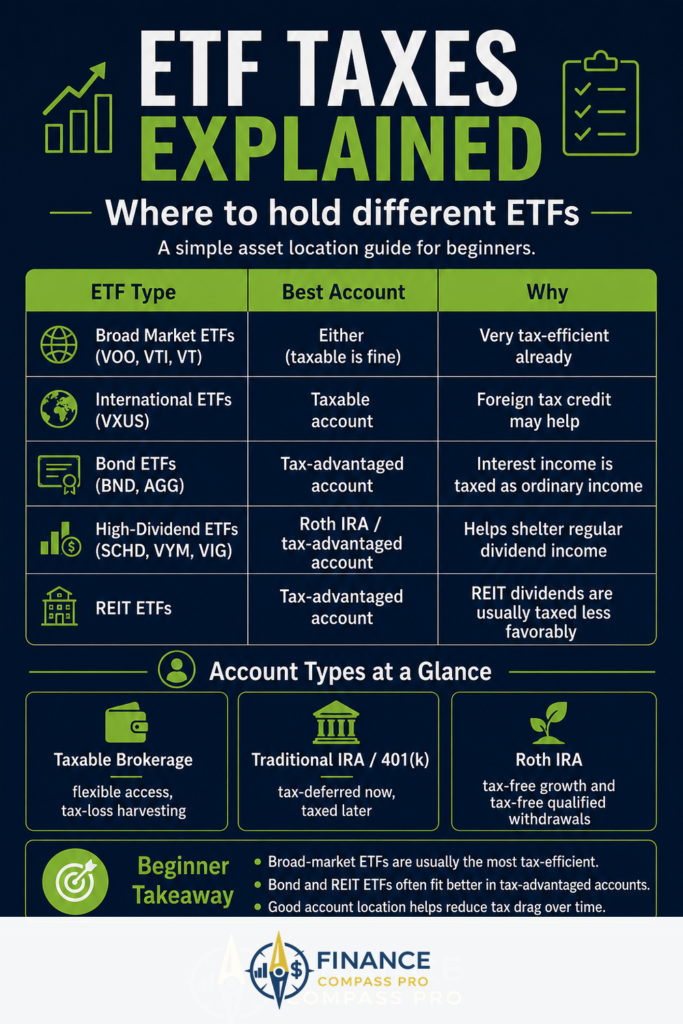
Asset location means putting each type of investment in the account where it is taxed most favorably. A common misconception is that you need to get this perfect before you start. In reality, the core idea is simple: shelter income-heavy funds, and hold tax-efficient funds anywhere. Here is a beginner framework.
| ETF Type | Best Account | Reason |
|---|---|---|
| Broad market ETFs (VOO, VTI, VT) | Either (taxable is fine) | Very tax-efficient already |
| International ETFs (VXUS) | Taxable account | Foreign tax credit only available in taxable accounts |
| Bond ETFs (BND) | Tax-advantaged (IRA, 401k) | Interest income taxed as ordinary income |
| High-dividend ETFs (SCHD, VYM) | Tax-advantaged (Roth IRA) | Shields dividend income from annual taxation |
| REIT ETFs | Tax-advantaged (Roth IRA) | Non-qualified dividends taxed at ordinary income rates |
This is a general framework – not a rule. Many investors hold all their ETFs in a single account type, especially early in their investing journey. That is fine. Even a suboptimal account location beats not investing at all.
3 Common Tax Mistakes Beginners Make
1. Selling too soon. Selling an ETF within a year of buying it converts a potential long-term gain into a short-term gain. That can more than double the tax rate on your profit. Holding just past the one-year mark often changes the tax picture significantly.
2. Ignoring dividend reinvestment tax. When your brokerage automatically reinvests dividends, that reinvestment is still a taxable event in a taxable account. Each reinvested dividend creates a new cost basis lot. Over years of investing, this adds complexity to your tax records.
3. Holding high-income ETFs in taxable accounts. REIT ETFs and high-dividend ETFs generate significant ordinary income each year. Holding them in a taxable account means paying taxes on those distributions annually. Moving them to a Roth IRA or Traditional IRA shelters that income entirely.
FAQ About ETF Taxes
A. In a taxable account, usually yes. Most ETFs pay dividends, and those dividends are taxable in the year you receive them. However, the shares themselves are not taxed until you sell. In a Roth IRA or Traditional IRA, no annual tax applies while the money stays inside the account.
A. Yes. Automatic reinvestment does not change the tax treatment. The IRS treats a reinvested dividend the same as a cash dividend. As a result, you owe tax on it in the year it was paid. Each reinvestment also creates a new cost basis lot, so good record-keeping helps at tax time.
A. You may still owe tax on dividends, but not on price growth. Unrealized gains are not taxed. So an ETF that rises in value creates no tax bill until you sell the shares. In a taxable account, dividends remain the main annual tax cost. This is one reason buy-and-hold investing tends to be tax-friendly.
A. Broad-market index ETFs like VOO and VTI are generally among the most tax-efficient. They have low turnover, rarely distribute capital gains, and pay mostly qualified dividends. In contrast, REIT ETFs and bond ETFs generate income taxed at ordinary rates. Therefore, many investors hold those inside tax-advantaged accounts instead.
A. Often, yes – in taxable accounts. ETFs use in-kind redemptions, so they rarely pass capital gains distributions to shareholders. Traditional mutual funds can distribute gains even to investors who never sold. However, inside an IRA or 401(k), the difference mostly disappears. Those accounts shelter distributions from annual tax either way.
A. For many beginners, a Roth IRA is an excellent home for ETFs. Dividends and capital gains grow tax-free, and qualified withdrawals in retirement are generally tax-free as well. High-dividend and REIT ETFs benefit the most from this shelter. As always, consider your own situation or consult a tax professional first.
The Bottom Line
ETFs are genuinely tax-efficient – but that efficiency is not automatic. It depends on how long you hold them, where you hold them, and which type of ETF you choose.
For most beginners, three habits cover most of the tax picture. Hold broad-market ETFs for more than one year. Prioritize tax-advantaged accounts for bond and dividend ETFs. And do not let tax complexity stop you from investing.
The biggest tax mistake most beginners make is not investing at all because taxes feel complicated. If that sounds familiar, start with one simple step today. Open or fund a tax-advantaged account, choose a diversified low-cost index ETF, and hold it for the long term. That single habit will matter far more than optimizing every tax detail.
For a look at how expense ratios and tax drag combine to affect your real returns, see ETF Expense Ratios Explained. And if you are still building your core portfolio, The 3-ETF Portfolio Strategy covers a simple structure that works well in both taxable and tax-advantaged accounts.